You know better.
You still do it anyway.
Emma catches the pattern while it’s running — in the draft, in the meeting, before the damage is done. On your own, with your team, or with the people closest to you.
We are opening her to thirty people and five teams.
A month each, free. No card.
Insight isn’t the problem.
You have done the assessments. You can name your triggers. And you still walk out of the same conversation having done the same thing — then spend the drive home going over it, and come back tomorrow no clearer about what was actually decided.
These are conditioned patterns of behavior — psychological wiring that runs on the ancient architecture of humanity itself.
Patterns don’t dissolve because people understand them. They dissolve when someone catches them running — and practices, in real time, doing something different.
Subtypes.
Not the nine-box version.
Emma is your Enneagram companion, built by Big Self School on the Enneagram’s 27 subtypes — not the nine-box version most people know. Nine types tell you someone is a Six. Twenty-seven tell you which Six, what instincts drive them most, how it shows up in a status update, and what makes them go quiet.
She doesn’t hand your team a type and wish you luck. She learns each person’s specific pattern — how it runs under deadline, in conflict, in the meeting where nobody says the real thing. Then she works with them, daily, right where they are, to catch it before it runs them — before it torpedoes the trust and the best-laid plans of the team.
She works where the work happens.
Emma isn’t another tab nobody opens. She meets people inside the actual day.
Your calendar.
Connect it and she sees the shape of your day — who you’re meeting, what’s stacked up — and opens the conversation herself when something matters.
Your email.
Before you hit send, show her the message — or the one that just landed wrong. She tells you what’s happening in you, how the other person is likely to hear it, and gives you a better version. Or just forward the email to her: she replies in about a minute.
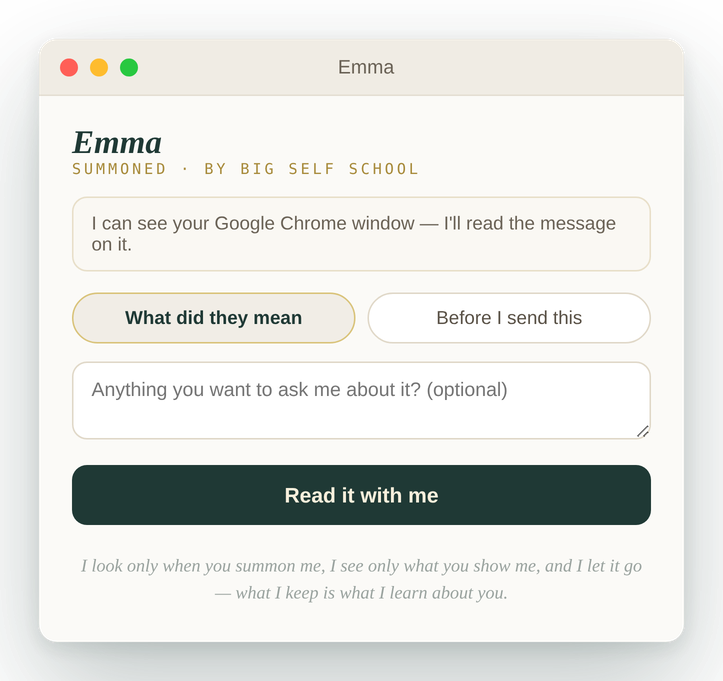
Right from your browser.
Summon her on whatever’s in front of you — the thread, the doc, the comment you’re staring at.
After the meeting.
She’ll debrief it with the lead: where the tension was, what each person likely needed, what to repair. Then an alignment check asks everyone what they think got decided — and shows the lead where the room actually agreed and where it only looked like it.
DRAFT · TO: SAM
Per my last email, the deadline was already agreed on. I need to understand why this keeps happening…
I · You, right now
You're not asking for a timeline. You're building the case that you were right — and you already know it.
II · How Sam will hear it
A slipped deadline from Sam is rarely defiance — it's overwhelm gone quiet. This reads as an indictment. He'll answer less, not more.
III · The words, last
Sam — I need us solid on the launch date, and I'd rather re-plan than pretend. What's actually in the way?
Last time you two were in a room
You cut Alex off twice during planning. He went quiet for the back half.
You said you'd — this is the room for it
The budget answer you promised him two weeks ago.
You, walking in
Under deadline you go brisk and call it clarity. Alex hears brisk as “the decision's already made.” Slow the first five minutes.
Two halves. The first one stands on its own — plenty of people use Emma with nobody else in it at all. The second needs other people: your team, or the few you choose.
Each person, personally.
An adaptive assessment and a real voice conversation — about an hour total, saveable, resumable. Then their Individual Report: their pattern, its gifts, what it costs them, and where the work is. Then a companion who remembers everything, checks in daily, and hands them one experiment a week aimed at where they actually are.
The team, collectively.
A shared map of how this specific group is built — where the blind spots cluster, which conversations keep stalling and why, what this team is really good at. Plus a team report you can hand to the lead that changes and adapts as your team does.
Click anyone · you are Maya, ringed in gold
Working with Priya
Priya Nair
Self-Preservation One · Anxiety / Worry
A lens for understanding and empathy, not a verdict. Hold it lightly.
Who they are
The most anxious One. Channels anger into worry and self-control. Tries to make everything right through meticulous effort. Warm but rigid underneath.
How they show up
Presents as warm, responsible, detail-oriented. May look like a Six due to anxiety. The anger is deeply repressed — shows as tension, perfectionism about practical matters, and a need to get things right before relaxing (which never comes).
What they can't see
How their worry is displaced anger. How their 'helpfulness' is actually a form of control. That their body holds enormous tension.
In the product this keeps going — how the two of you spark and clash, what each of you does under stress, and what to try in your next conversation.
What got decided about the launch?
We ship March 1, no matter what.
We ship when QA signs off. March 1 was a target.
I think marketing owns that call now?
3 VERSIONS OF 1 DECISION → TOMORROW'S FIRST AGENDA ITEM
And after a decision, the alignment check: three short questions to everyone who was in the room. The lead sees where the room actually agreed and where it only looked like it — without ever seeing anyone’s raw answers.
What the lead never gets: individual answers
A development tool. Not an evaluation tool.
And it never becomes one.
Not from HR, not by request, not by export — there is no screen in the product that returns anyone’s individual answers.
Who sees what
| You | Emma | Your teammates | Team lead | Big Self School | |
|---|---|---|---|---|---|
| Your name & Enneagram type | Yes | Yes | Yes — on the team map | Yes | Yes |
| Your Individual Report | Yes | Yes — she wrote it | No | No | No |
| Your assessment answers | Yes | Yes | No | No | No |
| Your intake, values, trust & stress answers | Yes | Yes | No | No | No |
| Your conversations with Emma | Yes | Yes | No | No | No |
| Team patterns — no names, no quotes | — | Yes | — | Yes | Yes |
Full details: How we handle your team’s data →
What Emma sees, and where it goes
Emma sees everything you give her. That’s the arrangement — she can’t reflect a pattern she isn’t allowed to look at. Your answers, your check-ins, your conversations with her: all of it is hers to work with, on your behalf and nobody else’s. About your teammates she knows exactly one thing — their type. What they tell her never reaches you, and what you tell her never reaches them.
Where it physically goes is a short list, and this is all of it:
Your data is stored in a dedicated Postgres database (Supabase), encrypted in transit and at rest, with row-level security and no public read access.
Emma runs on Claude, made by Anthropic. To do a given job, our server sends Anthropic what that job needs — your type, your team’s roster of names and types, and your own material when she’s working with you. Under Anthropic’s commercial terms, data sent through their API is not used to train their models. We don’t use it to train anything either.
Anything team-level is de-identified before it’s sent. Pre-work answers are bundled with no names attached, so themes can be found without being attributed to anyone.
Email goes through Resend. The app runs on Vercel. If you connect your calendar, Google sends us read-only access to your own calendar and nothing goes back. That is the entire list of companies that touch your data.
Built for a business to say yes to
Encrypted in transit and at rest, on a database locked down with row-level security and no public read access. Every read goes through our server, which checks who you are first.
Passwordless sign-in. No passwords to leak.
Your conversations with Emma are unreadable to us by design — not by policy, by architecture. There’s no admin path to them.
Drafts and transcripts are read once, never stored. There’s no table to keep them in, so they can’t be searched or re-read later.
Never sold. Never used for advertising. Never used to train AI models — ours or anyone’s.
Delete anything, anytime. Conversations delete instantly. Full deletion requests honored within 30 days.
Questions from HR or legal? Ask us directly and we’ll answer them — in writing, in plain language, from the person who built this.
Emma learned from a working coach.
Dr. Shelley Prevost is an educational psychologist, licensed therapist, board-certified coach, and founder of Big Self School — with a former tech CEO’s scar tissue and twenty years of sitting across from people whose patterns were quietly running the room.
Emma is that method, encoded. Every read she gives, every experiment she hands someone, traces back to how Shelley actually works with real people — and Shelley still reviews what Emma surfaces. A method, not a content library: the Enneagram at the level of motivation, not behavior, used surgically. In most workplace tools it’s a personality quiz. This is the other version.
We also published the document Emma is built from — what she believes, how she reads people, and the lines she won’t cross, including this one: she is not trying to become the most important relationship in your life. She’s built to send you back to the people in it. Read The Soul of Emma →

Dr. Shelley Prevost
Who this beta is for
We’re being specific about fit, because a beta only teaches us anything if the people in it are the right ones. Thirty individual places, and five for teams.
People who will actually use her.
Not people who want to look at it once. Emma gets more useful the more she has to go on, so one month of real use teaches us more than fifty signups that never came back.
People who will say the hard thing.
Polite encouragement is worth nothing to us. We want to hear where she was wrong about you, where it got boring, and where it made you uncomfortable.
An hour to start, then minutes.
Onboarding is about an hour, and you can stop and pick it back up. After that it’s minutes a day inside things you were already doing.
If you’re bringing a team — ideally 6 to 8 people.
Small enough that everyone is in the same rooms. People who actually work together week to week, not a department that shares a slide.
A leader willing to go first.
For a team, this works when the leader wants to understand their own pattern, not just hand a tool to everyone else. It does not land coming from someone who exempted themselves.
You don’t need the business case made to you.
You already know what it costs when people can’t talk straight. You’re not looking to be convinced. You’re looking for something that works.
Questions people ask before they say yes
Emma is your Enneagram companion, built by Big Self School on the Enneagram's 27 subtypes. She is not a chatbot you have to remember to open. She runs where the work happens: on a draft before you send it, in prep for a 1:1, after a meeting when three people leave with three versions of one decision. And she keeps a model of each person, not a chat history. You can use her on your own, with your team, or with the people closest to you.
Neither. Emma is your Enneagram companion. The coach is a human: Dr. Shelley Prevost, an educational psychologist, licensed therapist and board-certified coach who has spent twenty years across the table from people whose patterns were quietly running the room. Emma is that method encoded, and Shelley stays close to the whole beta.
An assessment tells you a teammate is a Six. Emma tells you which of the three Sixes they are, why they go quiet when the deadline moves, what that silence is protecting, and what to say next. Insight is not the problem; you can already name your triggers. Emma works with people daily, in real moments, so they catch the pattern while it is running instead of on the drive home.
Each of the nine types comes in three versions, depending on which instinct dominates: self-preservation, social, or one-to-one. A Self-Preservation Four, a Social Four and a Sexual Four are as different from one another as a Four is from a Seven. Nine boxes are enough for a fun team day. Twenty-seven are what it takes to say, precisely, what someone does under pressure and what would help.
No. Emma is a development tool, not an evaluation tool. Your intake, assessment answers, Individual Report and conversations with Emma are yours: not visible to your lead, not to HR, not by request, not by export. There is no screen in the product that returns anyone's individual answers. What the lead sees is team-level patterns with no names and no quotes. The same holds for the people you connect with outside work: they see your type, never your conversations, your book or your check-ins.
No. Your data lives in a dedicated Postgres database (Supabase), encrypted in transit and at rest with row-level security. Emma runs on Claude, made by Anthropic; under Anthropic's commercial terms, data sent through their API is not used to train their models, and we don't train anything on it either. Drafts and transcripts are read once and never stored. Nothing is sold or used for advertising, and conversations delete instantly on request.
About an hour per person: an adaptive assessment and a real voice conversation with Emma, both saveable and resumable. Then each person gets their Individual Report, and — if you are bringing a team — the team gets a shared map of how this specific group is built. After that it is minutes a day inside things you were already doing.
Thirty people and five teams. The individual places are open to anyone who will actually use her — on your own, or with the few people closest to you. The team places are for a functional team of roughly 6 to 8 who work together week to week, led by someone who wants to understand their own pattern rather than hand a tool to everyone else. Everyone gets a month of Emma free, starting the day you begin rather than the day we opened the door, and no card is needed. In exchange we want your honest reaction, especially the parts where we got it wrong.
A month each. Free.
Thirty people and five teams. Everything above, at no cost, for a month that starts the day you begin rather than the day we opened the door. No card. After that Emma becomes a paid product — you’ll hear the price before anything changes, and whatever she has already written for you stays yours. And you don’t only get software.
A kickoff with Shelley — for the five teams.
She opens the work with your team herself — in person if you’re within reach, live on video if you’re not. Not a demo. The actual first session.
Check-ins along the way.
Periodic sessions through the beta to hear what’s landing and what isn’t. You won’t be filing feedback into a void.
Direct input on what gets built.
A line straight to the people building her. In exchange we want your honest reaction — especially the parts where we got it wrong.